reviews
The Chicago Trib’s Nina Metz gives Song About Himself three stars, saying:
Ultimately Maher is digging his finger around in that gaping hole of what it means to connect with another person — the wistful, persistent desire for it, and the technology that we’ve come to rely on to make so much of it possible.
Full review.
posted 04/16/2015
TimeOut Chicago’s Kris Vire writes:
Borrowing equally from WWW and W.W.—as in Walt Whitman, whose Leaves of Grass plays into the virtual poetry—Maher crafts an engaging, resonant online ode.

Full review.
Photo by Evan Hanover.
posted 04/15/2015
Chicagoland’s ten-year-old theater-critic sensation (and actress in her own right) Ada Grey came to see Song About Himself and posted this thoughtful review.
Excerpt:
People who would like this show are people who like poetry, lengthy posts, and clarinets. I think people should definitely go see this show. It is eye-opening and it will blow your mind. And I actually think that while I was writing the review I understood it even better than when I was watching it. So, I think it would be good if when you got home you could write down some ideas that you had about the show and you can think about those ideas for a little while.
Full disclosure: Ada Grey’s dad, John Henry Roberts, is an Oobleck Irregular, having appeared in The Golden Election by Marilyn Quayle and her Sister and Theater Oobleck and our staged reading of The Forbidden Bestsellers of Pre-Revolutionary France.
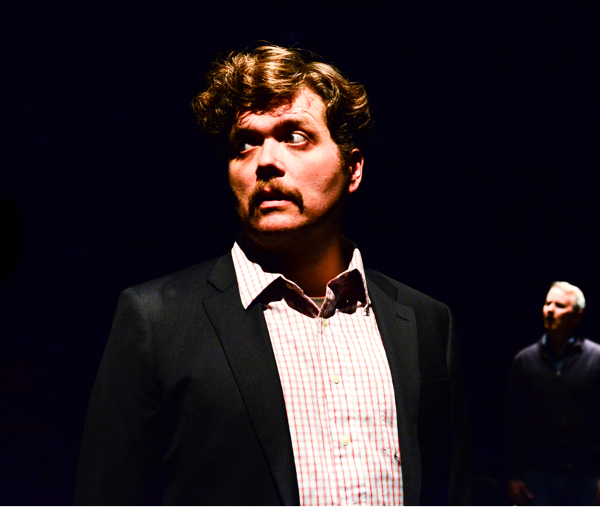
Photo by Evan Hanover.
posted 04/14/2015
Newcity’s Christopher Kidder-Mostrom writes:
While the piece pulls from Walt Whitman’s poetry, no knowledge of the source material is necessary to glean deep, impactful meaning from the show. It is a rich psychological and metaphysical landscape through which to travel, even for those not well-versed in “Leaves of Grass.”

Full review.
Photo by Evan Hanover.
posted 04/07/2015
The Chicago Reader’s Justin Hayford weighs in on Theater Oobleck’s new play:
In typical fashion, Maher creates a world of ridiculous, ominous inadequacy, given mesmerizing expression in this Theater Oobleck premiere…

Throughout, Maher borrows specific lines and images from Song of Myself—ironically, a work fundamentally about self-reliance—as well as Whitman’s thematic spirals, intoxicating rhythms, and circuitous plainspokenness, all rendered with great clarity and warmth by Oobleck’s cast: Guy Massey, Colm O’Reilly, and Diana Slickman, who, astonishingly, work without a director, as Oobleck has done for 26 years…
Full review.
Photo by Evan Hanover.
posted 04/03/2015
From Philip Montoro in The Chicago Reader.
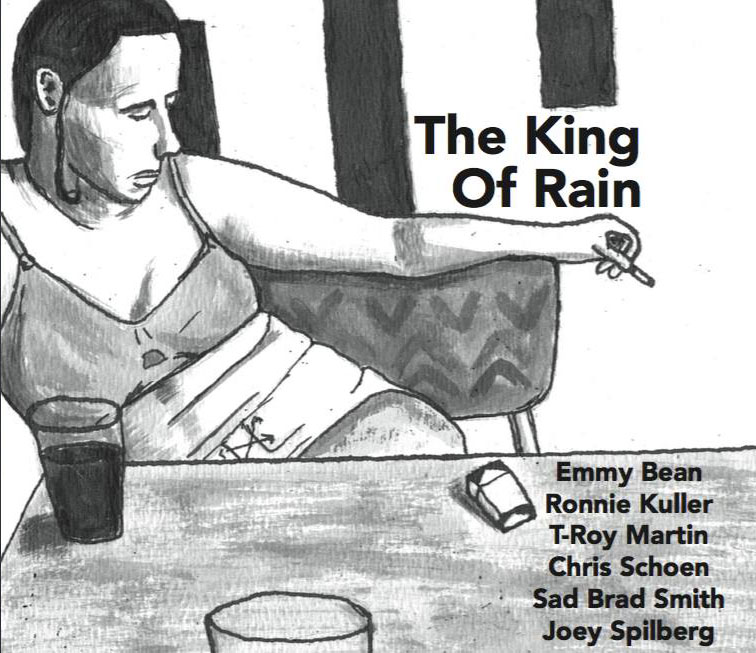
This seventh episode of Theater Oobleck’s Baudelaire in a Box sets lively new English translations of poems from the 1861 edition of Charles Baudelaire’s The Flowers of Evil to witty acoustic songs played by a six-piece ensemble…
The translations can be playful too—somehow I doubt Baudelaire’s original text uses “hummus” for a rhyme. Only once, on Sad Brad Smith’s rendition of “Grieving and Wandering,” does the troupe match bleak music to bleak verses, and the effect is so wrenchingly mournful it’s almost startling.
Full review here.
posted 12/11/2014
R.H. Palmer reviewed the third week of our Hideout residency.
Theater Oobleck…is wrapping up their June residency at the Hideout, 1354 W. Wabansia, on Tuesday with This Land That I Love, a musical interpretation of a book written by Ooblecker by John Shaw. Every week is different, so it’s hard to encapsulate the experience, but I have yet to be disappointed by Oobleck.
See the full review here
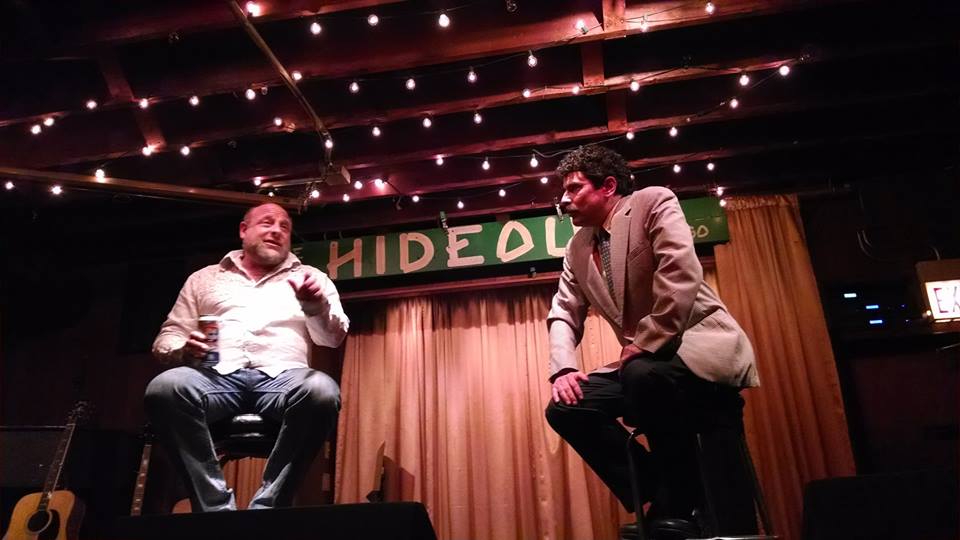
Photo by Matt Greenberger.
posted 06/23/2014
Theater Oobleck’s anthology of plays, More If You’ve Got It, was reviewed in the inaugural issue of the Chicago Art Journal.
Critic Kerry Reid said:
For me the one company that mattered, the one that challenged the old gods and old orthodoxies — of what a play means, of how it is created, of what yardsticks measure a “successful” company — was Theater Oobleck…
Read this collection. Pass it along. Produce these plays. Please.
Read the full Journal here. (It’s a 40-page pdf, so might take a couple minutes to download.)
posted 10/31/2013
Gapers Block came out to the Hideout Inn to catch our Baudelaire in a Box “Episode 5” reprise. They said:
Like Baudelaire’s poems, which connect profound urban ennui to sometimes bawdy, sometimes gory imagery, the illustrations linked one non-sequitur to the next with sometimes humorous, sometimes distressing strokes.
Although the French read Baudelaire with great seriousness, one can only imagine that the poet himself meant for them to be read — or sung — as they were last night
The full review is here.
We had a great night. We thank 80 Foots Per Minute for warming up, the incredible Ronnie Kuller for making us a part of her month-long musical residency, and the Hideout for hosting.
posted 10/03/2013
The Chicago Stage Review liked The Hunchback Variations Opera so much that a second reviewer has weighed in with a second rave review.
J. Scott Hill writes:
“…The Hunchback Variations Opera is a modern masterpiece.
“The premise of The Hunchback Variations Opera is like the beginning of a joke told at a Mensa meeting. Beethoven (who is deaf) and Quasimodo (who is deaf) hold a series of panel discussions about their failed attempts to create a unique sound that neither of them could hear anyway (because they’re deaf)… This is one level of the genius of playwright/librettist Mickle Maher: combining incompatible elements in ways that are absurdly plausible, and readily accessible to a broad audience.
“Enter the musical magnificence of Mark Messing. This is not Maher and Messing’s first dance together; notably, they provided the script and the score for Redmoon Theater’s signature show, The Cabinet. Messing’s score for two voices, piano, and cello allows for the interpretive power of these four voices to be fully realized without the fetters of over-orchestration. There are the clear influences here of Igor Stravinsky, Aaron Copland, and Philip Glass, without seeming derivative. Pianist Tim Lenihan and cellist Paul Ghica are less like musicians and more like puppeteers, making their instruments sing and emote in voice and in silence.
“George Andrew Wolff’s… tenor is round and full and robust.
“Larry Adams’s bass is sonorous yet subdued. He is pitch perfect in delivering what becomes increasingly cynical counterpoint to Wolff’s useless persistence.
“The Hunchback Variations Opera is funny and frustrating and absurd and poignant. The Hunchback Variations Opera is the most unlikely confluence of heterogeneous incompatibilities to ever work perfectly together onstage. Without doubt, The Hunchback Variations Opera is the DO NOT MISS production of the year in Chicago.
4 STARS
Full review here.
posted 03/06/2012
Oobleck’s recently extended production of The Hunchback Variations Opera continues to get rave notices from Chicago’s theater bloggers. Here we feature J.Scott Hill for the Chicago Stage Review and Rebecca Green from Chicago3Media.
Chicago Stage Review writes: “Enter the musical magnificence of Mark Messing… Messing’s score for two voices, piano, and cello allows for the interpretive power of these four voices to be fully realized without the fetters of over-orchestration. There are the clear influences here of Igor Stravinsky, Aaron Copland, and Philip Glass, without seeming derivative. Pianist Tim Lenihan and cellist Paul Ghica are less like musicians and more like puppeteers, making their instruments sing and emote in voice and in silence.
“George Andrew Wolff’s… tenor is round and full and robust… Larry Adams’s bass is sonorous yet subdued.
“The Hunchback Variations Opera is funny and frustrating and absurd and poignant… Without doubt, The Hunchback Variations Opera is the DO NOT MISS production of the year in Chicago. The Hunchback Variations Opera should be extended and re-extended for months, but you cannot take that chance. BUY YOUR TICKETS NOW.”
Full review here.
Chicago3Media writes: “Maher and composer Mark Messing bring us the inconceivable, side-stitching story of a doomed collaboration in this gem of new musical theater… Theater Oobleck has struck gold with this absurdist romp through time and space and reality and fantasy… I haven’t laughed so hard at the theater in a long time.”
Full review here
posted 02/21/2012
Andrew Patner, reviewing The Hunchback Variations Opera for classical musical station WFMT-FM:
“Oobleck [is] a company that works without a director — some of their shows have one or two people, and some have fifty, and yet somehow they come together as finely-tuned, choreographed, and presented as an orchestra concert led by Ricardo Muti… These guys are afraid of nothing…
“Mark Messing has created a musical world with Paul Ghica, cello; Tim Lenihan, piano; a wonderful tenor, George Andrew Wolff, as Beethoven; and an excellent mature basso, Larry Adams as Quasimodo… You will hear music that challenges and pleases, that questions and underscores the debate and discussion.”
The audio of the full review and can be streamed or downloaded here
posted 02/16/2012
Jonathan Abarbanel gives The Hunchback Variations Opera his “Pick of the Week” during the “Dueling Critics” segment on WBEZ’s 848 program:
“It is a dark comedy which has the delicious premise of having two stone-cold deaf people discussing the glories and wonders of sound. And the two people are Ludwig van Beethoven… and the fictional bell-ringer Quasimodo…
“Messing’s music preserves all of the wit of Maher’s original play, and deepens the characters…
“Beautifully performed: two wonderful singers, piano and cello accompaniment.”
Your link for listening (we’re discussed in the last three minutes of the broadcast).
posted 02/06/2012
Kris Vire writes for TimeOut Chicago:
“Mucca Pazza maestro Mark Messing, using Maher’s text as libretto, sets Beethoven and Quasi’s nettlesome forensics camp to a spiky score for piano and cello…
“The result is as serious as it is silly, with Messing’s music amping up the stakes with its contrapuntal vocals… Wolff and Adams find a remarkable range from glib comedy to soulful sorrow in their characters’ variations. Maher’s text, while reveling in its own absurdities, slowly becomes a worthy meditation on the irresistible and often frustrating character of the creative impulse—and the subsuming nature of creative failure. Though the staging is simple, the operatic sweep feels apropos.”
Full Review.
posted 02/06/2012
Albert Williams writes in the Chicago Reader:
“In The Cherry Orchard, Anton Chekhov’s melancholy comedy about a family of Russian aristocrats who lose their estate, there appears one of the most famous passages in dramatic literature. It’s not a speech or a bit of dialogue but a stage direction: “Suddenly there is a distant sound, as if from the sky: the sound of a breaking string—dying away, sad.” This odd, abstract, almost metaphysical sound effect, symbolizing the imminent end of a way of life, has challenged directors and designers since the play’s 1904 premiere, a few months before Chekhov’s own death from tuberculosis.
“The Hunchback Variations Opera takes its inspiration from that enduring dramaturgical koan, What is the sound of one string breaking? The 75-minute one-act from Theater Oobleck posits an attempt by two well-known musical artists to produce the ultimate aural embodiment of Chekhov’s elusive noise. The setting is an academic conference at which the pair are presenting the result of their labors.
“The effort seems to have been doomed from the start. For one thing, both collaborators are deaf. For another, it’s hard to imagine how they could ever have met. One is Beethoven, the composer, who’s been dead since 1827. The other is Quasimodo, the hunchbacked, 15th-century bell ringer of Notre Dame Cathedral in Paris—and a fictional character invented by Victor Hugo in an 1831 novel.
“The setup is quintessential Oobleck—smart, eccentric, unpredictable, thought-provoking, and very funny. Since they arrived in Chicago 23 years ago, the itinerant ensemble—which takes its name from a Dr. Seuss book, Bartholomew and the Oobleck—has specialized in original works based on incongruous cultural cross-references…
“Written by composer Mark Messing and librettist Mickle Maher, and based on a 2001 play by Maher, The Hunchback Variations Opera is just what the title says it is: an opera, albeit a small one. It takes the form of 11 variations on the theme of artistic experimentation and failure, each of which Messing skillfully couches in its own musical style. The score is generally atonal and mildly dissonant, but there are some simple, lovely, melodic passages.
“The singing is beautiful. George Andrew Wolff’s bright tenor contrasts effectively with Larry Adams’s round, chesty bass, and both singers have first-rate diction so the text is always clear. The counterpoint between Wolff’s cheerful, well-groomed Beethoven and Adams’s morose, grotesque Quasimodo is mirrored by the bold give-and-take of pianist Tim Lenihan and cellist Paul Ghica…
“What’s never made clear is how exactly the experiment failed. The omission, of course, is deliberate. Maher and Messing make clear that, in art, failure itself is a failed notion. In the manner of other fringe theaters—and contrary to an increasing emphasis on competition in the performing arts, as the media celebrate the “winners” and “losers” of meaningless talent contests and mindless awards shows—Oobleck renders the concept of failure and success moot. The Hunchback Variations Opera, like The Cherry Orchard, is a meditation on futility. But Hunchback celebrates its characters’ aspirations, prizing process over product and championing the quixotic urge to create and to collaborate in a world that’s inhospitable to both.”
Full review is here — but spoiler alert, if gives away a few of the jokes.
posted 02/06/2012
John Dalton writes: “This is a masterful work. Chicagoans should feel greatly privileged to have such artists in our midst. It would be very easy for this show to get overlooked amidst the flood of winter offerings from innumerable theater companies occupying innumerable black boxes about the city. Though I hate to encourage you to ignore any of them, please think about making this show a priority. Theater Oobleck shows are rare, but they are all gemstones; this is no exception. Please see it while you have the chance.”
Full review here.
posted 01/31/2012
Excerpts:
“Maher and Messing set off to create that impossible sound and in detailing a failed fantastical project they have realized an unmitigated, surprisingly endearing and impossibly successful masterpiece…
“Messing has composed a score for two voices, a piano and a cello that takes on more scope and achieves more musical depth than many works created for a full orchestra and chorus…
“Two geniuses have joined together to realize impossibility and it takes as much genius to bring it to life on stage. George Andrew Wolff is perfectly darling as Beethoven, holding the audience transfixed in his very cleverly subtle camp… Larry Adams is also a gold standard on the musical theater stage… Together with Wolff, Adams makes this impossible combination completely captivating. Their voices are wonderful and their performances are incredible.
“Tim Lenihan’s piano accompaniment is excellent and Paul Ghico interprets Messings unconventional cello compositions with evocative intuition…
“Theater Oobleck’s world premiere is a production the likes of which you cannot imagine. Mark Messing and Mickle Maher’s THE HUNCHBACK VARIATIONS OPERA is a staggering contemplation on the profundity of the unattainable. In peering into the void, they create a seemingly pointless exercise of thought that yields a transformation from the impossible to the sublime. Do not miss this singular masterpiece.”
Full Review
posted 01/27/2012
In December, we presented the first couple “variations” of our work-in-progress: The Hunchback Variations Opera.
Venus Zarris of the Chicago Stage Review was there, and submitted this glowing report:
“This is NOT the stuff of standard theater, MUCH LESS standard opera. It IS the stuff of an absurdist masterpiece. Maher’s writing is cerebral and acerbic. Little to nothing about this script lends itself to music, much less the constructs of opera, but Messing takes the traditional framework of operatic composition and applies a musical quantum physics to perfectly meet The Hunchback Variations somewhere in the midst of the its unreal realm. We heard only a handful of movements to the opera. That was more than enough to know that we were in the audience of something extraordinary.”
See her full report here.
posted 07/18/2011
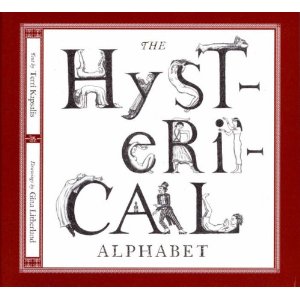
Theater Oobleck makes its Indiana debut, with this one-night-only performance of The Hysterical Alphabet.
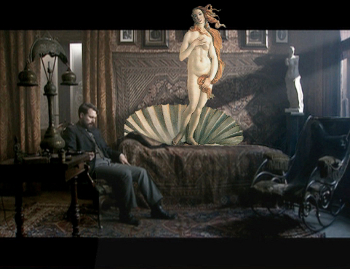
The details: The University of Notre Dame (co-sponsored by Gender Studies Program) presents The Hysterical Alphabet, Wednesday, February 16, 2011, 8 pm, at Browning Cinema, DeBartolo Performing Arts Center.
It is free, but is a ticketed event. For tickets phone 574-631-2800 or visit performingarts.nd.edu.
More details are at the Gender Studies website
This hit show — a collaboration between author Terri Kapsalis, video-collagist Danny Thompson, and sound artist John Corbett — is currently touring American campuses. So far it has been seen at Bates College, the University of Illinois Urbana-Champaign, Clark University, the Rhode Island School of Design, and Emory College.
An appreciation of the performance at Emory is here … to quote:
“In a refreshingly non-didactic, yet pedagogical performance, Theater Oobleck’s The Hysterical Alphabet, is an example of what a 21st-century hybrid of art and scholarship might be.”
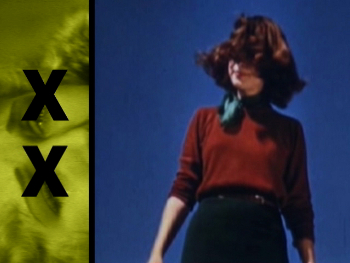
In addition, following its Chicago premiere, the work was reviewed in Newcity.
“Theatre Oobleck’s “The Hysterical Alphabet” is a beautifully nuanced mixture of historical treatise, medical discourse and poetic archive, chronicling the sometimes hilarious, often horrifying saga of the “female malady” that is hysteria throughout the centuries. Oobleck has remounted their inspired multimedia presentation at the Chopin Theatre, after premiering last fall in a one-night-only showing at the Gene Siskel Film Center. Terry Kapsalis’s remarkable text, an ABC’s of women and their wily wombs (now available in book form with fantastic drawings by Gina Litherland), is the axis material, but accompanied by Danny Thompson’s stunning video “documentary,” and John Corbett’s gratifying sound design, the sum transforms into something greater than its (private) parts. The three artists enter quietly, without fanfare, and take seats at a long table before a large projection screen. Aided by microphones, a computer/projector, record player and numerous sound folio devises, the performance/lecture takes off, with Kapsalis reading matter-of-factly, almost demurely, her lyrical chronology of ailment, while Thompson frenzy of found and original video images unfurl to the tunes (and crackles, cries and whistles) of Corbett’s manic soundscape. The trio packs an astounding amount of information into little more than an hour’s time—delivering a lesson that is wickedly funny, surprisingly heart-wrenching and not to be missed. (Valerie Jean Johnson)”
You can see an video excerpt of the play here and can order the book version here
posted 02/16/2011
From Nina Metz, who makes a compelling case that Colm O’Reilly = JFK + Orson Welles.
“O’Reilly gives a performance filled with incredible detail and subtlety, each twitch and twinge delivered in close-up. … Here is an actor plainly having the time of his life.”
posted 09/30/2009
older